About

Thursday, 3 November 2011

Greece

Greece also known as Hellas (Ancient Greek: Ἑλλάς, Hellás, IPA: [hellás]) and officially the Hellenic Republic (Ελληνική Δημοκρατία, Ellīnikī́ Dīmokratía, IPA: [eliniˈci ðimokraˈtia]), is a country in southeastern Europe.

Greece has land borders with Albania, the Republic of Macedonia and Bulgaria to the north, and Turkey to the east. The Aegean Sea lies to the east of mainland Greece, the Ionian Sea to the west, and the Mediterranean Sea to the south. Greece has the twelfth longest coastline in the world at 13,676 km (8,498 mi) in length, featuring a vast number of islands (approximately 1,400, of which 227 are inhabited), including Crete, the Dodecanese, the Cyclades, and the Ionian Islands among others. Eighty percent of Greece consists of mountains, of which Mount Olympus is the highest at 2,917 m (9,570 ft).

Spring in Agrafa, in the Pindus mountains

Modern Greece traces its roots to the civilization of ancient Greece, generally considered the cradle of Western civilization. As such, it is the birthplace of democracy, Western philosophy, the Olympic Games, Western literature and historiography, political science, major scientific and mathematical principles, university education, coinage, and Western drama, including both tragedy and comedy. This legacy is partly reflected in the seventeen UNESCO World Heritage Sites located in Greece, ranking Greece 7th in Europe and 13th in the world. The modern Greek state was established in 1830, following the Greek War of Independence.

Piraeus is the largest port in Greece.

A developed country with an advanced, high-income economy and very high standards of living (including the 22nd highest Human Development Index in the world as of 2010, Greece has been a member of what is now the European Union since 1981 and the eurozone since 2001, NATO since 1952, and the European Space Agency since 2005. It is also a founding member of the United Nations, the Organisation for Economic Co-operation and Development, and the Organization of the Black Sea Economic Cooperation.

Athens is the capital and the largest city in the country (its urban area also including Piraeus).

The Parthenon on the Acropolis of Athens.

Name
The name of Greece differs in Greece in comparison with the names used for the country in other languages and cultures, just like the names of the Greeks. Although the Greeks call the country Hellas or Ellada (Greek: Ελλάς, Ελλάδα) and its official name is Hellenic Republic, in English the country is called Greece, which comes from Latin Graecia as used by the Romans and literally means 'the land of the Greeks'; however, the name Hellas is sometimes used in English too.

Detail of the Alexander Mosaic, depicting Alexander the Great on his horse Bucephalus
Climate
Greece primarily has a Mediterranean climate, featuring mild, wet winters and hot, dry summers. This climate occurs at all coastal locations, including Athens, the Cyclades, the Dodecanese, Crete, the Peloponnese and parts of the Sterea Ellada (Central Continental Grece) region. The Pindus mountain range strongly affects the climate of the country, as areas to the west of the range are considerably wetter on average (due to greater exposure to south-westerly systems bringing in moisture) than the areas lying to the east of the range (due to a rain shadow effect).

Navagio (shipwreck) bay, in Zakynthos.

The mountainous areas of Northwestern Greece (parts of Epirus, Central Greece, Thessaly, Western Macedonia) as well as in the mountainous central parts of Peloponnese – including parts of the prefectures of Achaia, Arcadia and Laconia – feature an Alpine climate with heavy snowfalls. The inland parts of northern Greece, in Central Macedonia and East Macedonia and Thrace feature a temperate climate with cold, damp winters and hot, dry summers with frequent thunderstorms. Snowfalls occur every year in the mountains and northern areas, and brief snowfalls are not unknown even in low-lying southern areas, such as Athens.

View of Mount Olympus, located on the border between Thessaly and Macedonia.
Tourism
An important percentage of Greece's national income comes from tourism. According to Eurostat statistics, Greece welcomed over 19.5 million tourists in 2009, which is an increase from the 17.7 million tourists it welcomed in 2007. The vast majority of visitors in Greece in 2007 came from the European continent, numbering 12.7 million, while the most visitors from a single nationality were those from the United Kingdom, (2.6 million), followed closely by those from Germany (2.3 million). In 2010, the most visited periphery of Greece was that of Central Macedonia, with 18% of the country's total tourist flow (amounting to 3.6 million tourists), followed by Attica with 2.6 million and the Peloponnese with 1.8 million.Northern Greece is the country's most-visited geographical region, with 6.5 million tourists, while Central Greece is second with 6.3 million.

The Hellenic Parliament in central Athens

In 2010, Lonely Planet ranked Greece's northern and second-largest city of Thessaloniki as the world's fifth-best party town worldwide, comparable to other cities such as Dubai and Montreal. In 2011, Santorini was voted as "The World's Best Island" in Travel + Leisure. Its neighboring island Mykonos, came in fifth in the European category.

Night view of Fira, Santorini.
Transport
Since the 1980s, the road and rail network of Greece has been significantly modernized. Important works include the Egnatia Odos that connects northwestern Greece (Igoumenitsa) with northern and northeastern Greece (Kipoi). The Rio–Antirrio bridge, the longest suspension cable bridge in Europe, (2250 m or 7382 ft long) connects the western Peloponnese from Rio(7 km or 4 mi from Patras) with Antirrio in Central Greece.

The Rio-Antirio bridge near the city of Patras is the longest cable-stayed bridge in Europe and second in the world.

An expansion of the Patras-Athens motorway towards Pyrgos in the western Peloponnese is scheduled to be completed by 2014. Most of the motorway connection from Athens to Thessaloniki has also been upgraded.

Athens
The Athens Metropolitan Area includes state of the art infrastructure such as the Athens International Airport, the privately run motorway Attiki Odos and the expanded Athens Metro system. Most of the Greek islands and many main cities of Greece are connected by air mainly from the two major Greek airlines, Olympic Air and Aegean Airlines. Maritime connections have been improved with modern high-speed craft, including hydrofoils and catamarans.

Thessaloniki

Railway connections play a somewhat lesser role than in many other European countries, but they too have also been expanded, with new suburban/commuter rail connections, serviced by Proastiakos around Athens, towards its airport, Kiato and Chalkida; and around Thessaloniki, towards the cities of Larissa and Edessa. A modern intercity rail connection between Athens and Thessaloniki has also been established, while an upgrade to double lines in many parts of the 2,500 km (1,600 mi) network is underway. International railway lines connect Greek cities with the rest of Europe, the Balkans and Turkey, although as of 2011 they have been suspended, due to the financial crisis.
Central square in Nafplion, the first capital of modern Greece
The Hermoupolis port in the island of Syros is the capital of the Cyclades.

 Holy Trinity monastery, in Meteora, central Greece
The Academy of Athens is Greece's national academy and the highest research establishment in the country.


Rhodes , Greece

Palace of the Grand Master in the city of Rhodes

Rhodes (Greek: Ρόδος, Ródos, [ˈroðos]) is an island in Greece, located in the eastern Aegean Sea. It is the largest of the Dodecanese islands in terms of both land area and population, with a population of 117,007, and also the island group's historical capital. Administratively the island forms a separate municipality within the Rhodes peripheral unit, which is part of the South Aegean Periphery. The principal town of the island and seat of the municipality is Rhodes. The city of Rhodes had 53,709 inhabitants in 2001. It is located northeast of Crete, southeast of Athens and southwest of the Anatolian coast in Turkey.

A nighttime view from the old town of Rhodes

Historically, Rhodes was famous worldwide for the Colossus of Rhodes, one of the Seven Wonders of the Ancient World. The medieval Old Town of the City of Rhodes has been declared a World Heritage Site. Today, it is one of the most popular tourist destinations in Europe.

Ruins of Kameiros
Transportation
Road network
The road network of the island is mostly modern and paved. There are four major arteries:

l   Rhodes-Kamiros Province Avenue: Two lane, runs through the west coast north to south and connects Rhodes City with Diagoras Airport and Kamiros.
l   Rhodes-Lindos National Avenue (Greek National Road 95): Four and two lane, runs mainly inland north to south and connects Rhodes City with Lindos.
l   Rhodes-Kallithea Province Avenue: Two lane, runs through the east coast north to south and connects Rhodes City with Faliraki Resort.
l   Tsairi-Airport National Avenue: Four and two lane, runs inland east to west and connects the east coast with the west and the airport.
Future roads:

l   Further widening of E-95 from Faliraki to Lindos. This is to be four lane with jersey barrier in the middle, about 36 km (22 mi) in length, with the first part scheduled to start in August 2007.
l   Plans also exist for a new four lane express road connecting Rhodes Town with Diagoras Airport that will reduce congestion on the coastal west avenue.
l   The first phase of construction of the Rhodes City ringway was begun a few years ago, but progress has been slow.

The Acropolis of Lindos
Cars and motorbikes
Families in Rhodes often own more than one car, along with a motorbike. Traffic jams are common particularly in the summer months. The island is served by 450 taxis.

Mandraki harbor during night
Bus
Bus services are handled by two operators:

l   RODA: Rhodes City company that also services suburban areas (Faliraki, Ialysos, Kremasti, Airport, Pastida, Maritsa, Paradeisi) and the entire west coast (blue-white colored).
l   KTEL: State-owned buses that serve villages and resorts in the east coast (yellow-orange colored).
Ruins of Apollo Temple at the Acropolis of Rhodes
Air
The ATC tower and part of the terminal of Diagoras AirportRhodes has three airports but only one is public. Diagoras Airport, one of the biggest in Greece, is the main entrance/exit point for both locals and tourists. The island is well connected with other major Greek cities and islands as well as with major European capitals and cities via charter flights.

l   Rhodes International Airport, "Diagoras": public airport, 14 km (9 mi) south west of Rhodes City, third in international passenger volume and fourth in total passenger volume in Greece.
l   Rhodes Maritsa Airport: closed to public, near Maritsa village. Built in 1938 by the Italians was the first airport of the island and used to be the public airport until 1977. Nowadays serves the Hellenic Air Force and is sometimes used for car races.
l   Kalathos Airfield: inoperative, 7 km (4 mi) north of Lindos. Built by the Italians during World War II, was called Aeroporto di Gadurrà. Today only the runway is visible.
l   Kattavia Airstrip, located in the south of the island it was an emergency airstrip built by the Italians during World War II. Today it is abandoned.
 Two pilot schools offer aviation services (small plane rental, island hopping).

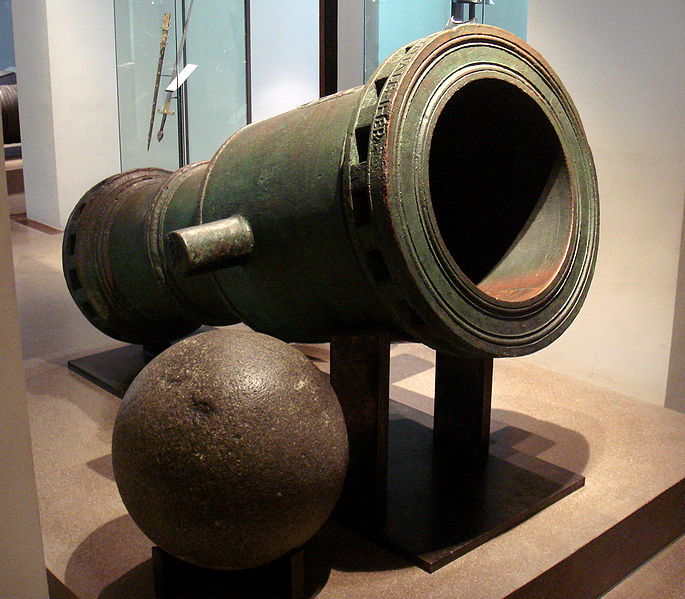
Mortar of the Knights of Saint John of Jerusalem (Knights Hospitaller), Rhodes, 1480–1500, fired 260 lb (118 kg) cannon balls.
Sea
Rhodes has five ports, three of them in Rhodes City, one in the west coast near Kamiros and one in east coast near Lardos.

l   Central Port: located in the city of Rhodes serves domestic and international traffic.
l   Kolona Port: opposite the central port, serves intra-Dodecanese traffic and large yachts.
l   Akandia Port: the new port of the island next to the central port, being built since 1960s, for domestic and international traffic. At the moment serves cruise ships on peak days.
l   Kamiros Skala Dock: 30 km (19 mi) south west of the city near Ancient Kamiros ruins serves mainly the island of Halki
l   Lardos Dock: formerly servicing local industries, now under development as an alternative port for times when the central port is inaccessible due to weather conditions. It is situated in a rocky shore near the village of Lardos in south east Rhodes.
The castle of Monolithos
Culture
Sports
l   Football: AS Rodos and Diagoras F.C., both Rhodes City based teams, compete professionally at the national level. Local football leagues (organized at the prefecture level) contain three divisions with more than 50 teams. Many stadiums are grass covered.
l   Basketball: Colossus BC sponsors professional basketball and has joined the Greek A1 League. The local league includes two divisions with 14 teams. Two indoor courts exist in Rhodes City, and one each in Ialysos and Kremasti. Several other are planned for Rhodes City Pales De Sports, Faliraki, Afantou, and South Rhodes.
l   Volleyball: local teams only.
l   Water Polo: mostly amateur based. There is no single indoor pool on the island.
l   Rugby: introduced in 2007. Teams compete at the national level.
l   Tennis: tennis has a long history on the island.
l   Sailing: widely developed, offers competition at the international level.
l   Cycling: for a long period of time Rhodes had the only cycling track in Greece, producing Olympics level competitors.
l   Rhodes competes in the bi-annual Island Games, which it hosted in 2007.
Church in Kremasti
In popular culture
l   In ancient times there was a Roman saying: "Hic Rhodus, hic salta!"—"Rhodes is here, here perform your jump", an admonition to prove one's idle boasts by deed rather than talk. It comes from an Aesop's fable called "The Boastful Athlete", and was cited by Hegel and Marx.
l   Lawrence Durrell's Reflections on a Marine Venus (1953) is the author's semi-autobiographical account of his stay on the Island after World War II.
l   Many of the outdoor scenes of The Guns of Navarone (starring Gregory Peck, David Niven and Anthony Quinn) and Escape to Athena (starring Roger Moore and Telly Savalas) were filmed on the island of Rhodes.
l   In the PlayStation 2 game God of War II, both Rhodes and the Colossus of Rhodes are featured at the start of the game, offering a mythological theory as to how the Colossus was destroyed. The Colossus of Rhodes is a common feature in many games, for example, it can be built as a "Wonder" in Rise of Nations and the Civilization series of games.
l   In one book of the Roman Mysteries series of children's novels by Caroline Lawrence, the main characters visit Rhodes to stop the trading of slave labour.
Panorama of Lindos
Palace of the (Prince) Grand Master—Rhodes
Modern bronze deer statues in Mandraki harbor, where the Colossus of Rhodes may have stood
Diagoras Stadium


Wednesday, 2 November 2011

Kos , Greece

Kos or Cos (Greek: Κως) is a Greek island in the south Sporades group of the Dodecanese, next to the Gulf of Gökova/Cos. It measures 40 kilometres (25 mi) by 8 kilometres (5.0 mi), and is 4 kilometres (2.5 mi) from the coast of Bodrum, Turkey and the ancient region of Caria. Administratively the island forms a separate municipality within the Kos peripheral unit, which is part of the South Aegean Periphery. The principal town of the island and seat of the municipality is Kos town.The island has a population of 30,947.

Culture
The main port and population centre on the island, also called Kos, is also the tourist and cultural centre, with whitewashed buildings including many hotels, restaurants and a small number of nightclubs forming the famous Kos town "barstreet". The town has a 14th century fortress at the entrance to its harbour, erected in 1315 by The Knights of Saint John of Rhodes.

Asfendiou Monastery of Zia.

The ancient physician Hippocrates is thought to have been born on Kos, and in the center of the town is the Plane Tree of Hippocrates, a dream temple where the physician is traditionally supposed to have taught. The limbs of the now elderly tree are supported by scaffolding. The small city is also home to the International Hippocratic Institute and the Hippocratic Museum dedicated to him. Near the Institute are the ruins of Asklepieion, where Herodicus taught Hippocrates medicine. Kardamena is a popular resort for young British holidaymakers and has a large number of bars and nightclubs.
 Hippocrates' statue.
 The Cathedral of the city of Kos.
The harbour of Kos (city).
View of the municipal market.
 View of the ancient Odeon.
Ruins of the Ancient Gymnasium.
View of the Asclepeion.


Tuesday, 1 November 2011

Mount Olympus , Greece

Mount Olympus

Mount Olympus (Greek: Όλυμπος ; also transliterated as Olympos, and on Greek maps, Oros Olympos) is the highest mountain in Greece, located on the border between Thessaly and Macedonia, about 100 kilometres (62 mi) away from Thessaloniki, Greece's second largest city. Mount Olympus has 52 peaks. The highest peak Mytikas, meaning "nose", rises to 2,917 metres (9,570 ft). It is one of the highest peaks in Europe in terms of topographic prominence.

Mount Olympus is noted for its very rich flora with several species. It is a National Park of Greece and a World's Biosphere Reserve.

Olympus' highest peak, Mytikas
The abode of the gods
In Greek mythology Olympus was regarded as the "home" of the Twelve Olympian gods of the ancient Greek world. It formed itself after the gods defeated the titans in the Titan War, and soon the palace was inhabited by the gods. It is the setting of many Greek mythical stories. Olympus was not shaken by winds nor ever wet with rain, nor did snow fall upon it, but the air is outspread clear and cloudless, and over it hovered a radiant whiteness.

Mount Olympus: View from Litochoro
Climbing
Climbing Mount Olympus is a non-technical hike, except for the final section from Skala summit to Mitikas summit, which is YDS class 3 rock scramble. It is estimated that 10,000 people climb Mount Olympus each year, most of them reaching only the Skolio summit.

View from Papa Aloni gorge

Most climbs to Mount Olympus start from the town of Litochoro, which took the name City of Gods because of its location on the roots of the mountain. A local from Litochoro, Christos Kakalos, became the first to reach the Mitikas summit on 2 August 1913. From there a road goes to Prionia, where the hike begins at the bottom of the mountain.

Prionia, Mount Olympus
Coin
Mount Olympus and the national Park around it were selected as the main motif for the Greek National Park Olympus commemorative coin, minted in 2005. On the reverse, the War of the Titans on Mount Olympus is portrayed along with flowering branches on the lower part of the coin. Above the scene is written, in Greek, "National Park Olympus".
Olympus South Peaks

 
Design by Free WordPress Themes | Bloggerized by Lasantha - Premium Blogger Themes | Best Buy Coupons