Greece also known as Hellas (Ancient Greek: Ἑλλάς, Hellás, IPA: [hellás]) and officially the Hellenic Republic (Ελληνική Δημοκρατία, Ellīnikī́ Dīmokratía, IPA: [eliniˈci ðimokraˈtia]), is a country in southeastern Europe.
Greece has land borders with Albania, the Republic of Macedonia and Bulgaria to the north, and Turkey to the east. The Aegean Sea lies to the east of mainland Greece, the Ionian Sea to the west, and the Mediterranean Sea to the south. Greece has the twelfth longest coastline in the world at 13,676 km (8,498 mi) in length, featuring a vast number of islands (approximately 1,400, of which 227 are inhabited), including Crete, the Dodecanese, the Cyclades, and the Ionian Islands among others. Eighty percent of Greece consists of mountains, of which Mount Olympus is the highest at 2,917 m (9,570 ft).
Spring in Agrafa, in the Pindus mountains
Modern Greece traces its roots to the civilization of ancient Greece, generally considered the cradle of Western civilization. As such, it is the birthplace of democracy, Western philosophy, the Olympic Games, Western literature and historiography, political science, major scientific and mathematical principles, university education, coinage, and Western drama, including both tragedy and comedy. This legacy is partly reflected in the seventeen UNESCO World Heritage Sites located in Greece, ranking Greece 7th in Europe and 13th in the world. The modern Greek state was established in 1830, following the Greek War of Independence.
Piraeus is the largest port in Greece.
A developed country with an advanced, high-income economy and very high standards of living (including the 22nd highest Human Development Index in the world as of 2010, Greece has been a member of what is now the European Union since 1981 and the eurozone since 2001, NATO since 1952, and the European Space Agency since 2005. It is also a founding member of the United Nations, the Organisation for Economic Co-operation and Development, and the Organization of the Black Sea Economic Cooperation.
Athens is the capital and the largest city in the country (its urban area also including Piraeus).
The Parthenon on the Acropolis of Athens.
Name
The name of Greece differs in Greece in comparison with the names used for the country in other languages and cultures, just like the names of the Greeks. Although the Greeks call the country Hellas or Ellada (Greek: Ελλάς, Ελλάδα) and its official name is Hellenic Republic, in English the country is called Greece, which comes from Latin Graecia as used by the Romans and literally means 'the land of the Greeks'; however, the name Hellas is sometimes used in English too.
Detail of the Alexander Mosaic, depicting Alexander the Great on his horse Bucephalus
Climate
Greece primarily has a Mediterranean climate, featuring mild, wet winters and hot, dry summers. This climate occurs at all coastal locations, including Athens, the Cyclades, the Dodecanese, Crete, the Peloponnese and parts of the Sterea Ellada (Central Continental Grece) region. The Pindus mountain range strongly affects the climate of the country, as areas to the west of the range are considerably wetter on average (due to greater exposure to south-westerly systems bringing in moisture) than the areas lying to the east of the range (due to a rain shadow effect).
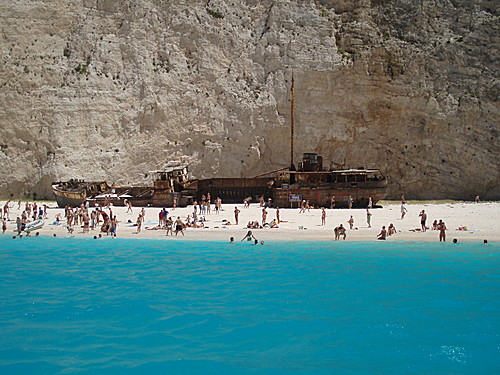
Navagio (shipwreck) bay, in Zakynthos.
The mountainous areas of Northwestern Greece (parts of Epirus, Central Greece, Thessaly, Western Macedonia) as well as in the mountainous central parts of Peloponnese – including parts of the prefectures of Achaia, Arcadia and Laconia – feature an Alpine climate with heavy snowfalls. The inland parts of northern Greece, in Central Macedonia and East Macedonia and Thrace feature a temperate climate with cold, damp winters and hot, dry summers with frequent thunderstorms. Snowfalls occur every year in the mountains and northern areas, and brief snowfalls are not unknown even in low-lying southern areas, such as Athens.
View of Mount Olympus, located on the border between Thessaly and Macedonia.
Tourism
An important percentage of Greece's national income comes from tourism. According to Eurostat statistics, Greece welcomed over 19.5 million tourists in 2009, which is an increase from the 17.7 million tourists it welcomed in 2007. The vast majority of visitors in Greece in 2007 came from the European continent, numbering 12.7 million, while the most visitors from a single nationality were those from the United Kingdom, (2.6 million), followed closely by those from Germany (2.3 million). In 2010, the most visited periphery of Greece was that of Central Macedonia, with 18% of the country's total tourist flow (amounting to 3.6 million tourists), followed by Attica with 2.6 million and the Peloponnese with 1.8 million.Northern Greece is the country's most-visited geographical region, with 6.5 million tourists, while Central Greece is second with 6.3 million.
The Hellenic Parliament in central Athens
In 2010, Lonely Planet ranked Greece's northern and second-largest city of Thessaloniki as the world's fifth-best party town worldwide, comparable to other cities such as Dubai and Montreal. In 2011, Santorini was voted as "The World's Best Island" in Travel + Leisure. Its neighboring island Mykonos, came in fifth in the European category.
Night view of Fira, Santorini.
Transport
Since the 1980s, the road and rail network of Greece has been significantly modernized. Important works include the Egnatia Odos that connects northwestern Greece (Igoumenitsa) with northern and northeastern Greece (Kipoi). The Rio–Antirrio bridge, the longest suspension cable bridge in Europe, (2250 m or 7382 ft long) connects the western Peloponnese from Rio(7 km or 4 mi from Patras) with Antirrio in Central Greece.
The Rio-Antirio bridge near the city of Patras is the longest cable-stayed bridge in Europe and second in the world.
An expansion of the Patras-Athens motorway towards Pyrgos in the western Peloponnese is scheduled to be completed by 2014. Most of the motorway connection from Athens to Thessaloniki has also been upgraded.
Athens
The Athens Metropolitan Area includes state of the art infrastructure such as the Athens International Airport, the privately run motorway Attiki Odos and the expanded Athens Metro system. Most of the Greek islands and many main cities of Greece are connected by air mainly from the two major Greek airlines, Olympic Air and Aegean Airlines. Maritime connections have been improved with modern high-speed craft, including hydrofoils and catamarans.
Thessaloniki
Railway connections play a somewhat lesser role than in many other European countries, but they too have also been expanded, with new suburban/commuter rail connections, serviced by Proastiakos around Athens, towards its airport, Kiato and Chalkida; and around Thessaloniki, towards the cities of Larissa and Edessa. A modern intercity rail connection between Athens and Thessaloniki has also been established, while an upgrade to double lines in many parts of the 2,500 km (1,600 mi) network is underway. International railway lines connect Greek cities with the rest of Europe, the Balkans and Turkey, although as of 2011 they have been suspended, due to the financial crisis.
Central square in Nafplion, the first capital of modern Greece
The Hermoupolis port in the island of Syros is the capital of the Cyclades.
The Academy of Athens is Greece's national academy and the highest research establishment in the country.


 22:36
22:36
 homesweethome