This is featured post 1 title
Replace these every slider sentences with your featured post descriptions.Go to Blogger edit html and find these sentences.Now replace these with your own descriptions.
This is featured post 2 title
Replace these every slider sentences with your featured post descriptions.Go to Blogger edit html and find these sentences.Now replace these with your own descriptions.
This is featured post 3 title
Replace these every slider sentences with your featured post descriptions.Go to Blogger edit html and find these sentences.Now replace these with your own descriptions.
Showing posts with label TURKEY. Show all posts
Thursday, 4 August 2011
Turkey
Turkey , known officially as the Republic of Turkey ( Türkiye Cumhuriyeti (help·info)), is a Eurasian country located 97% in Asia (mostly in the Anatolian peninsula) and 3% in East Thrace in Europe. Turkey is bordered by eight countries: Bulgaria to the northwest; Greece to the west; Georgia to the northeast; Armenia, Azerbaijan (the exclave of Nakhchivan) and Iran to the east; and Iraq and Syria to the southeast.
The Mediterranean Sea and Cyprus are to the south; the Aegean Sea to the west; and the Black Sea is to the north. The Sea of Marmara, the Bosphorus and the Dardanelles (which together form the Turkish Straits) demarcate the boundary between East Thrace and Anatolia; they also separate Europe and Asia.
The Celsus Library in Ephesus, dating from 135 AD
Turkey is one of the six independent Turkic states. The vast majority of the population are Muslims. The country's official language is Turkish, whereas Kurdish and Zazaki languages are spoken by Kurds and Zazas, who comprise 18% of the population.
Turks began migrating into the area now called Turkey (derived from the Medieval Latin Turchia, i.e. "Land of the Turks") in the 11th century. The process was greatly accelerated by the Seljuk victory over the Byzantine Empire at the Battle of Manzikert.Several small beyliks and the Seljuk Sultanate of Rûm ruled Anatolia until the Mongol Empire's invasion.
Starting from the 13th century, the Ottoman beylik united Anatolia and created an empire encompassing much of Southeastern Europe, Western Asia and North Africa. After the Ottoman Empire collapsed following its defeat in World War I, parts of it were occupied by the victorious Allies.
Bosphorus Bridge in Istanbul, connecting Europe (left) and Asia (right.)
A cadre of young military officers, led by Mustafa Kemal Atatürk and his colleagues, organized a successful resistance to the Allies; in 1923, they would establish the modern Republic of Turkey with Atatürk as its first president.
Turkey is a democratic, secular, unitary, constitutional republic with an ancient cultural heritage. Turkey has become increasingly integrated with the West through membership in organizations such as the Council of Europe, NATO, OECD, OSCE and the G-20 major economies.
Turkey began full membership negotiations with the European Union in 2005, having been an associate member of the European Economic Community since 1963 and having reached a customs union agreement in 1995. Turkey has also fostered close cultural, political, economic and industrial relations with the Middle East, the Turkic states of Central Asia and the African countries through membership in organizations such as the Turkic Council, Joint Administration of Turkic Arts and Culture, Organisation of Islamic Cooperation and the Economic Cooperation Organization.
Turkey's location at the crossroads of Europe and Asia makes it a country of significant geostrategic importance. Given its strategic location, large economy and military strength, Turkey is a major regional power.
One of the main entrance gates of the Dolmabahçe Palace in Istanbul
The Sultan Ahmed Mosque in Istanbul
One of the fastest growing airline companies in the world, Turkish Airlines was chosen as the official carrier by Europe's leading football clubs like FC Barcelona and Manchester United. The company is also the primary sponsor of Euroleague Basketball
The historic İstiklal Avenue in Istanbul's cosmopolitan Beyoğlu district
Turkey - 聖蘇菲亞大教堂 Ayasofya (St.Sophia) ,Hagia Sophia in Turkey
Hagia Sophia
Hagia Sophia is a former Orthodox patriarchal basilica, later a mosque, and now a museum in Istanbul, Turkey. From the date of its dedication in 360 until 1453, it served as the Greek Patriarchal cathedral of Constantinople, except between 1204 and 1261, when it was converted to a Roman Catholic cathedral under the Latin Patriarch of Constantinople of the Western Crusader established Latin Empire.
Lustration urn from Pergamon
The building was a mosque from 29 May 1453 until 1931, when it was secularized. It was opened as a museum on 1 February 1935.
Interior view of the Hagia Sophia, showing Islamic elements on the top of the main dome
The Church was dedicated to the Logos, the second person of the Holy Trinity,[2] its dedication feast taking place on 25 December, the anniversary of the incarnation of the Logos in Christ. Although it is sometimes referred to as Sancta Sophia (as though it were named after Saint Sophia), sophia is the phonetic spelling in Latin of the Greek word for wisdom – the full name in Greek being Ναός τῆς Ἁγίας τοῦ Θεοῦ Σοφίας, "Church of the Holy Wisdom of God".
Famous in particular for its massive dome, it is considered the epitome of Byzantine architecture and is said to have "changed the history of architecture." It was the largest cathedral in the world for nearly a thousand years, until Seville Cathedral was completed in 1520.
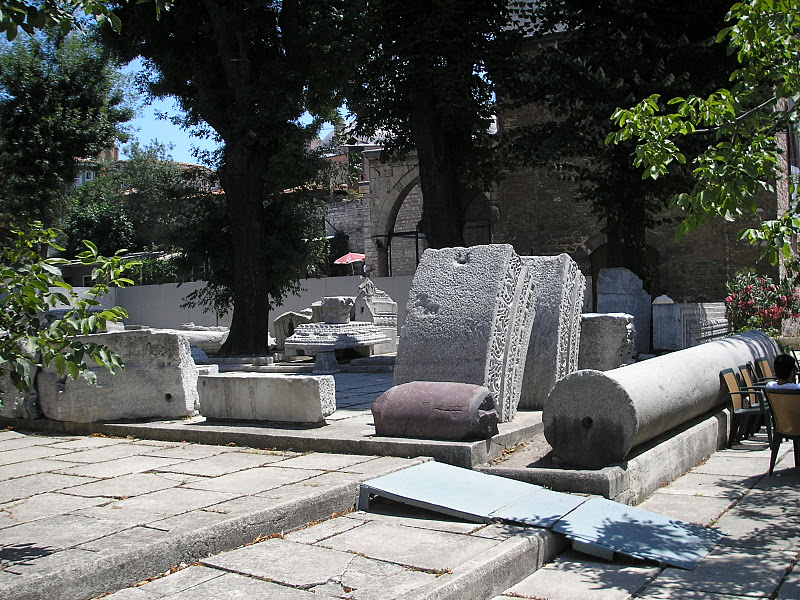
Marble blocks from the second church
The current building was originally constructed as a church between 532 and 537 on the orders of the Byzantine Emperor Justinian and was the third Church of the Holy Wisdom to occupy the site, the previous two having both been destroyed by rioters. It was designed by the Greek scientists Isidore of Miletus, a physicist, and Anthemius of Tralles, a mathematician.
The church contained a large collection of holy relics and featured, among other things, a 49 foot (15 m) silver iconostasis. It was the seat of the Patriarch of Constantinople and the religious focal point of the Eastern Orthodox Church for nearly one thousand years. It is the church in which Cardinal Humbert in 1054 excommunicated Michael I Cerularius – which is commonly considered the start of the Great Schism.
Fountain (Şadırvan) for ritual ablutions
The mihrab located in the apse where the altar used to stand, pointing towards Mecca
One of the mighty stone columns with metal clasps
In 1453, Constantinople was conquered by the Ottoman Turks under Sultan Mehmed II, who subsequently ordered the building converted into a mosque. The bells, altar, iconostasis, and sacrificial vessels were removed and many of the mosaics were plastered over.
nterior of the Hagia Sophia by John Singer Sargent, 1891
Islamic features – such as the mihrab, minbar, and four minarets – were added while in the possession of the Ottomans. It remained a mosque until 1931 when it was closed to the public for four years. It was re-opened in 1935 as a museum by the Republic of Turkey.
For almost 500 years the principal mosque of Istanbul, Hagia Sophia served as a model for many other Ottoman mosques, such as the Sultan Ahmed Mosque (Blue Mosque of Istanbul), the Şehzade Mosque, the Süleymaniye Mosque, the Rüstem Pasha Mosque and the Kılıç Ali Paşa Mosque.
Imperial Gate
Marble Door
The face of one of the cherub in the upper left corner, once covered by the Ottomans, is visible again
Kerkey - 藍色清真寺 (藍廟) SULTAN AHMED MOSQUE (THE BLUE MOSQUE)
The Sultan Ahmed Mosque (Turkish: Sultanahmet Camii) is a historical mosque in Istanbul, the largest city in Turkey and the capital of the Ottoman Empire (from 1453 to 1923). The mosque is popularly known as the Blue Mosque for the blue tiles adorning the walls of its interior.
Old photo of the Blue Mosque, taken before 1895
It was built between 1609 and 1616, during the rule of Ahmed I. Like many other mosques, it also comprises a tomb of the founder, a madrasah and a hospice. While still used as a mosque, the Sultan Ahmed Mosque has also become a popular tourist attraction.
Courtyard of the mosque, at dusk time
After the Peace of Zsitvatorok (1606) and the unfavourable result of the wars with Persia, Sultan Ahmed I decided to build a large mosque in Istanbul as recompense. This would be the first imperial mosque to be built in more than forty years. Whereas his predecessors had paid for their mosques with their war booty, Sultan Ahmed I had to withdraw the funds from the treasury, because he had not won any notable victories. This provoked the anger of the ulema, the Muslim legal scholars.
Two tourists staring at the Blue mosque in the Sultan Ahmed park
The mosque was to be built on the site of the palace of the Byzantine emperors, facing the Hagia Sophia (at that time the most venerated mosque in Istanbul) and the hippodrome, a site of great symbolic significance. Large parts of the southern side of the mosque rest on the foundation and vaults of the Great Palace. Several palaces had already built there, most notably the palace of Sokollu Mehmet Paşa, so these first had to be bought at a considerable cost and pulled down.
Large parts of the Sphendone (curved tribune with U-shaped structure of the hippodrome) were also removed to make room for the new mosque. Construction of the mosque started in August 1609 when the sultan himself came to break the first sod. It was his intention that this would become the first mosque of his empire. He appointed his royal architect Sedefhar Mehmet Ağa, a pupil and senior assistant of the famous architect Mimar Sinan to be in charge of the construction
The Blue Mosque with all six minarets visible
The organization of the work was described in meticulous detail in eight volumes, now found in the library of the Topkapı Palace. The opening ceremonies were held in 1617 (although the inscription on the gate of the mosque says 1616). The sultan could now pray in the royal box (hünkâr mahfil).
The building was not yet finished in this last year of his reign, as the last accounts were signed by his successor Mustafa I. Known as the Blue Mosque, Sultan Ahmed Mosque is one of the most impressive monuments in the world.
The mosque was depicted on the reverse of the Turkish 500 lira banknotes of 1953-1976
Arcaded forecourt with one of the entrance gates
Turkey - 以弗所古城Ephesus in Turkey
Ephesus (Ancient Greek Ἔφεσος, Ephesos; Turkish Efes) was an ancient Greek city, and later a major Roman city, on the west coast of Asia Minor, near present-day Selçuk, Izmir Province, Turkey. It was one of the twelve cities of the Ionian League during the Classical Greek era. In the Roman period, it was for many years the second largest city of the Roman Empire; ranking behind Rome, the empire's capital. Ephesus had a population of more than 250,000 in the 1st century BC, which also made it the second largest city in the world.
Site of the Temple of Artemis in the town of Selçuk, near Ephesus
The city was famed for the Temple of Artemis (completed around 550 BC), one of the Seven Wonders of the Ancient World. The temple was destroyed in 401 AD by a mob led by St. John Chrysostom. Emperor Constantine I rebuilt much of the city and erected new public baths. The town was again partially destroyed by an earthquake in 614 AD. The city's importance as a commercial center declined as the harbor was slowly silted up by the Cayster River (Küçük Menderes).
Theater.
Ephesus was one of the seven churches of Asia that are cited in the Book of Revelation. The Gospel of John may have been written here. The city was the site of several 5th century Christian Councils, see Council of Ephesus. It is also the site of a large gladiators' graveyard.
Temple of Hadrian
Today's archaeological site lies 3 kilometers southwest of the town of Selçuk, in the Selçuk district of İzmir Province, Turkey. The ruins of Ephesus are a favorite international and local tourist attraction, partly owing to their easy access from Adnan Menderes Airport and via the port of Kuşadası
Artist Simon Kozhin Ephesus. Ruins Temple of Hadrian
Main sites
Ephesus contains the largest collection of Roman ruins in the eastern Mediterranean. Only an estimated 15% has been excavated. The ruins that are visible give some idea of the city's original splendor, and the names associated with the ruins are evocative of its former life. The theater dominates the view down Harbour Street, which leads to the silted-up harbor.
The Library of Celsus, the façade of which has been carefully reconstructed from all original pieces, it was originally built c. 125 AD in memory of Tiberius Julius Celsus Polemaeanus, an Ancient Greek[30] who served as governor of Roman Asia (105–107) in the Roman Empire. Celsus paid for the construction of the library with his own personal wealth,and is buried in a sarcophagus beneath it.
The library was mostly built by his son Gaius Julius Aquila and once held nearly 12,000 scrolls. Designed with an exaggerated entrance — so as to enhance its perceived size, speculate many historians — the building faces east so that the reading rooms could make best use of the morning light.
Roman Library of Celsus
A part of the site, Basilica of St. John, was built in the 6th century AD, under emperor Justinian I over the supposed site of the apostle's tomb. It is now surrounded by Selçuk.
Gate of Augustus
The Temple of Artemis, one of the Seven Wonders of the Ancient World, is represented only by one inconspicuous column, revealed during an archaeological excavation by the British Museum in the 1870s. Some fragments of the frieze (which are insufficient to suggest the form of the original) and other small finds were removed – some to London and some to the Archaeological Museum, Istanbul.
The Odeon was a small roofed theater constructed by Vedius Antonius and his wife around 150 AD. It was a small salon for plays and concerts, seating about 1,500 people. There were 22 stairs in the theater. The upper part of the theater was decorated with red granite pillars in the Corinthian style. The entrances were at both sides of the stage and reached by a few steps.
The Temple of Hadrian dates from the 2nd century but underwent repairs in the 4th century and has been reerected from the surviving architectural fragments.
The reliefs in the upper sections are casts, the originals being now exhibited in the Ephesus Archaeological Museum. A number of figures are depicted in the reliefs, including the emperor Theodosius I with his wife and eldest son. The temple was depicted on the reverse of the Turkish 20 million lira banknote of 2001–2005 and of the 20 new lira banknote of 2005–2009.
The Temple of Domitian was one of the largest temples in the city. It was erected on a pseudodipteral plan with 8 x 13 columns. The temple and its statue are some of the few remains connected with Domitian.
At an estimated 44,000 seating capacity, the Theater is believed to be the largest outdoor theater in the ancient world.
The Tomb/Fountain of Pollio was erected in 97 AD in honor of C. Sextilius Pollio, who constructed the Marnas aqueduct, by Offilius Proculus. It has a concave facade.
There were two agoras, one for commercial and one for state business.
09:04
homesweethome