About

Wednesday, 23 November 2011

Capitoline Hill

The Capitoline Hill ( /ˈkæpɨtəlaɪn/ or /kəˈpɪtɵlaɪn/; Latin: Collis Capitōlīnus), between the Forum and the Campus Martius, is one of the seven hills of Rome. It was the citadel (equivalent of the ancient Greek acropolis) of the earliest Romans. By the 16th century, Capitolinus had become Capitolino in Italian, with the alternative Campidoglio stemming from Capitolium. The English word capitol derives from Capitoline. The Capitoline contains few ancient ground-level ruins, as they are almost entirely covered up by Medieval and Renaissance palaces (now housing the Capitoline Museums) that surround a piazza, a significant urban plan designed by Michelangelo.

 The Capitoline Hill cordonata (centre of picture) leading from Via del Teatro di Marcello to Piazza del Campidoglio.
 View from the Piazza del Campidoglio
 Replica of the equestrian statue of Marcus Aurelius.
 Piazza del Campidoglio, on the top of Capitoline Hill, with the façade of Palazzo Senatorio
A close up of the cordonata on the Capitoline Hill. The steps on the left lead to the church of Santa Maria in Aracoeli


Castel Sant'Angelo

Castel Sant'Angelo from the bridge. The top statue depicts the angel from whom the building derives its name.

The Mausoleum of Hadrian, usually known as the Castel Sant'Angelo, is a towering cylindrical building in Parco Adriano, Rome, Italy. It was initially commissioned by the Roman Emperor Hadrian as a mausoleum for himself and his family. The building was later used by the popes as a fortress and castle, and is now a museum.

The view from Castel Sant'Angelo towards Vatican City
Hadrian's tomb
The tomb of the Roman emperor Hadrian, also called Hadrian's mole, was erected on the right bank of the Tiber, between 135 AD and 139 AD. Originally the mausoleum was a decorated cylinder, with a garden top and golden quadriga. Hadrian's ashes were placed here a year after his death in Baiae in 138 AD, together with those of his wife Sabina, and his first adopted son, Lucius Aelius, who also died in 138 AD. Following this, the remains of succeeding emperors were also placed here, the last recorded deposition being Caracalla in 217 AD. The urns containing these ashes were probably placed in what is now known as the Treasury room deep within the building. Hadrian also built the Pons Aelius facing straight onto the mausoleum – it still provides a scenic approach from the center of Rome and the right bank of the Tiber, and is renowned for the Baroque additions of statues of angels holding aloft elements of the Passion of Christ.

The original angel by Raffaello da Montelupo.
Destruction
Much of the tomb contents and decorations have been lost since the building's conversion to a military fortress in 401 and its subsequent inclusion in the Aurelian Walls by Flavius Augustus Honorius. The urns and ashes were scattered by Visigoth looters during Alaric's sacking of Rome in 410, and the original decorative bronze and stone statuary were thrown down upon the attacking Goths when they besieged Rome in 537, as recounted by Procopius. An unusual survivor, however, is the capstone of a funerary urn (probably that of Hadrian), which made its way to Saint Peter's Basilica and was incorporated into a massive Renaissance baptistery. The use of spolia from the tomb in the post-Roman period was noted in the 16th century - Giorgio Vasari writes:

...in order to build churches for the use of the Christians, not only were the most honoured temples of the idols [pagan Roman gods] destroyed, but in order to ennoble and decorate Saint Peter's with more ornaments than it then possessed, they took away the stone columns from the tomb of Hadrian, now the castle of Sant'Angelo, as well as many other things which we now see in ruins.
Legend holds that the Archangel Michael appeared atop the mausoleum, sheathing his sword as a sign of the end of the plague of 590, thus lending the castle its present name.


Museum
Decommissioned in 1901, the castle is now a museum, the Museo Nazionale di Castel Sant'Angelo.

Ponte Sant'Angelo which leads to the Castel Sant'Angelo.
Popular culture
The Castel Sant'Angelo appeared in Dan Brown's 2000 novel Angels & Demons. The location was the secret lair for the Hassassin and was seen as the last existing church of the Illuminati. The book also emphasized the Passetto di Borgo as a secret way of getting from the Vatican to the castle. It also appears in the 2009 motion picture, Angels & Demons, as one of the locations where a clue that leads to the papal assassin.

The castle appeared in the film Roman Holiday in a scene taking place on barges on the river below.

Verschaffelt's replacement.

In Puccini's opera, Tosca, the Castel is where Cavaradossi is held prisoner. After murdering Scarpia in his private room at the Palazzo Farnese, Floria Tosca goes to the Castel Sant'Angelo, safe conducts in hand, where her lover, Mario Cavaradossi is to be executed. She has been led to believe it will be a mock execution and is horrified to find her lover dead. Rather than be arrested by Scarpia's henchmen, she throws herself from the rooftop.

The castle is one of the settings of Endymion and The Rise of Endymion, books in the Hyperion Cantos by author Dan Simmons. In the novels it has been relocated, along with large parts of the Vatican to the fictional planet Pacem. It serves as a prison and site of the torture of several protagonists in the novels, which include a resurgent version of the Catholic Church being the major power in human society.

In 1980, the American punk rock band The Ramones played a concert outside the castle and also the hard rock band Kiss played an outside show at the Castel.

In the Trinity Blood novels, a castle called San Angelo is the seat of power for the Catholic Church, though it is not known whether this is the same castle as the one in real life.

The Castel appears in the 2009 video game Assassin's Creed II and also more prominently in the game's 2010 sequel, Assassin's Creed: Brotherhood. In both games it is used as the official residence of Pope Alexander VI and his children, Cesare and Lucrezia Borgia. The Castel is protected by the Papal Guard as well as many Roman guard. During Assassin's Creed: Brotherhood, the Castel is infiltrated by the main character, Ezio Auditore, in an attempt to rescue Caterina Sforza and again later when trying to recover one of the "Pieces of Eden". It appears again in the Assassin's Creed: Brotherhood downloadable content, The Da Vinci Disappearance, when Ezio must infiltrate the Castel to steal two paintings by Leonardo da Vinci. Also in Assassin's Creed: Brotherhood you can gain a trophy for jumping from the top of the Castel Sant'Angelo with a parachute.

The design of the McKinley National Memorial in Canton, Ohio, which is the final resting place of US President William McKinley and his family, was based upon the Tomb of Hadrian according to its architect, Harold Van Buren Magonigle.


Trevi Fountain

The Trevi Fountain

The Trevi Fountain is a fountain in the Trevi rione in Rome, Italy. Standing 26 metres (85.3 feet) high and 20 metres (65.6 feet) wide, it is the largest Baroque fountain in the city and one of the most famous fountains in the world.

Trevi Fountain at night

Pre-1629 history of the aqueduct and the fountain site
The fountain at the junction of three roads (tre vie) marks the terminal point of the "modern" Acqua Vergine, the revived Aqua Virgo, one of the ancient aqueducts that supplied water to ancient Rome. In 19 BC, supposedly with the help of a virgin, Roman technicians located a source of pure water some 13 km (8.1 mi) from the city. (This scene is presented on the present fountain's façade.) However, the eventual indirect route of the aqueduct made its length some 22 km (14 mi). This Aqua Virgo led the water into the Baths of Agrippa. It served Rome for more than four hundred years. The coup de grâce for the urban life of late classical Rome came when the Goth besiegers in 537/38 broke the aqueducts. Medieval Romans were reduced to drawing water from polluted wells and the Tiber River, which was also used as a sewer.

Panorama of the Trevi Fountain

The Roman custom of building a handsome fountain at the endpoint of an aqueduct that brought water to Rome was revived in the 15th century, with the Renaissance. In 1453, Pope Nicholas V finished mending the Acqua Vergine aqueduct and built a simple basin, designed by the humanist architect Leon Battista Alberti, to herald the water's arrival.

Panorama of the Trevi Fountain at night

Commission, construction and design
In 1629 Pope Urban VIII, finding the earlier fountain insufficiently dramatic, asked Gian Lorenzo Bernini to sketch possible renovations, but when the Pope died, the project was abandoned. Though Bernini's project was torn down for Salvi's fountain, there are many Bernini touches in the fountain as it was built. An early, striking and influential model by Pietro da Cortona, preserved in the Albertina, Vienna, also exists, as do various early 18th century sketches, most unsigned, as well as a project attributed to Nicola Michetti one attributed to Ferdinando Fuga and a French design by Edme Bouchardon.

The asso di coppe

Competitions had become the rage during the Baroque era to design buildings, fountains, and even the Spanish Steps. In 1730 Pope Clement XII organized a contest in which Nicola Salvi initially lost to Alessandro Galilei – but due to the outcry in Rome over the fact that a Florentine won, Salvi was awarded the commission anyway. Work began in 1732, and the fountain was completed in 1762, long after Clement's death, when Pietro Bracci's Oceanus (god of all water) was set in the central niche.

The fountain filled with coins, from another perspective

Salvi died in 1751, with his work half-finished, but before he went he made sure a stubborn barber's unsightly sign would not spoil the ensemble, hiding it behind a sculpted vase, called by Romans the asso di coppe, the "Ace of Cups".

The Trevi Fountain was finished in 1762 by Giuseppe Pannini, who substituted the present allegories for planned sculptures of Agrippa and "Trivia", the Roman virgin.

Fontana di Trevi by night

Restoration
The fountain was refurbished in 1998; the stonework was scrubbed and the fountain provided with recirculating pumps.

Iconography
The backdrop for the fountain is the Palazzo Poli, given a new facade with a giant order of Corinthian pilasters that link the two main stories. Taming of the waters is the theme of the gigantic scheme that tumbles forward, mixing water and rockwork, and filling the small square. Tritons guide Oceanus' shell chariot, taming hippocamps.

In the centre a robustly-modelled triumphal arch is superimposed on the palazzo façade. The centre niche or exedra framing Oceanus has free-standing columns for maximal light and shade. In the niches flanking Oceanus, Abundance spills water from her urn and Salubrity holds a cup from which a snake drinks. Above, bas reliefs illustrate the Roman origin of the aqueducts.

The tritons and horses provide symmetrical balance, with the maximum contrast in their mood and poses (by 1730, rococo was already in full bloom in France and Germany).

Coin throwing
A traditional legend holds that if visitors throw a coin into the fountain, they are ensured a return to Rome. This was the theme of 1954's Three Coins in the Fountain and the Academy Award winning song by that name which introduced the picture.

An estimated 3,000 euros are thrown into the fountain each day. The money has been used to subsidize a supermarket for Rome's needy. However, there are regular attempts to steal coins from the fountain.

In popular culture
The Trevi fountain is featured in Respighi's symphonic pictures Fontane di Roma, and was the setting for an iconic scene in Federico Fellini's film La dolce vita starring Anita Ekberg and Marcello Mastroianni. The fountain was turned off and draped in black in honor of Mastroianni after the actor's death in 1996. The fountain is used for some scenes in the 1953 film Roman Holiday, starring Audrey Hepburn and Gregory Peck. Part of the fountain is replicated at the Italy Pavilion at Epcot in Walt Disney World, USA. The fountain itself is also a stage in Tekken Tag Tournament 2.

Tuesday, 22 November 2011

Piazza del Popolo

Piazza del Popolo is a large urban square in Rome. The name in modern Italian literally means "People's Square", but historically it derives from the poplars (populus in Latin, pioppo in Italian) after which the church of Santa Maria del Popolo, in the northeast corner of the piazza, takes its name.

The piazza lies inside the northern gate in the Aurelian Walls, once the Porta Flaminia of ancient Rome, and now called the Porta del Popolo. This was the starting point of the Via Flaminia, the road to Ariminum (modern day Rimini) and the most important route to the north. At the same time, before the age of railroads, it was the traveller's first view of Rome upon arrival. For centuries, the Piazza del Popolo was a place for public executions, the last of which took place in 1826.

The Piazza del Popolo, looking west from the Pincio.
Valadier's design
The layout of the piazza today was designed in neoclassical style between 1811 and 1822 by the architect Giuseppe Valadier, He removed a modest fountain by Giacomo Della Porta, erected in 1572, and demolished some insignificant buildings and haphazard high screening walls to form two semicircles, reminiscent of Bernini's plan for St. Peter's Square, replacing the original cramped trapezoidal square centred on the Via Flaminia.

Valadier's Piazza del Popolo, however, incorporated the verdure of trees as an essential element; he conceived his space in a third dimension, expressed in the building of the viale that leads up to the balustraded overlook from the Pincio (above, right).

An Egyptian obelisk of Ramesses II from Heliopolis stands in the centre of the Piazza

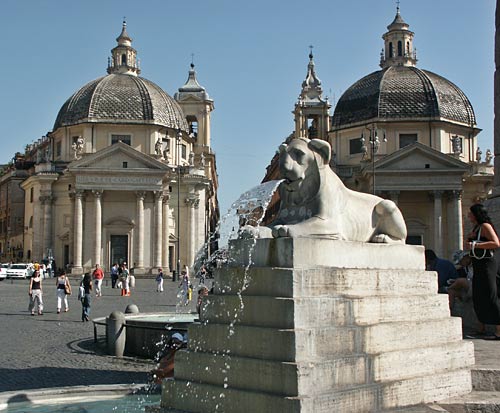
An Egyptian obelisk of Sety I (later erected by Rameses II) from Heliopolis stands in the centre of the Piazza. Three sides of the obelisk were carved during the reign of Sety I and the fourth side, under Rameses II. The obelisk, known as the obelisco Flaminio or the Popolo Obelisk, is the second oldest and one of the tallest obelisks in Rome (some 24 m high, or 36 m including its plinth). The obelisk was brought to Rome in 10 BC by order of Augustus and originally set up in the Circus Maximus. It was re-erected here in the piazza by the architect-engineer Domenico Fontana in 1589 as part of the urban plan of Sixtus V. The piazza also formerly contained a central fountain, which was moved to the Piazza Nicosia in 1818, when fountains, in the form of Egyptian-style lions, were added around the base of the obelisk.

The entrance of the Tridente from Piazza del Popolo, defined by the "twin" churches of Santa Maria in Montesanto (left, built 1662-75) and Santa Maria dei Miracoli (right, built 1675-79). The Via del Corso exits between the two churches.

Looking from the north (illustration, right), three streets branch out from the piazza into the city, forming the so-called "trident" (il Tridente): the Via del Corso in the centre; the Via del Babuino to the left (opened in 1525 as the Via Paolina) and the Via di Ripetta (opened by Leo X in 1518 as the Via Leonina) to the right. The twin churches (the chiese gemelle) of Santa Maria dei Miracoli (1681) and Santa Maria in Montesanto (1679), begun by Carlo Rainaldi and completed by Bernini and Carlo Fontana, define the junctions of the roads. Close scrutiny of the twin churches reveals that they are not mere copies of one another, as they would have been in a Neoclassical project, but vary in their details, offering variety within their symmetrical balance in Baroque fashion.

One side of the Fontana dell'Obelisco.

The central street, now known as the Via del Corso, was the ancient Via Lata and to the north it links with the ancient Roman road, the Via Flaminia,beyond the city gate and southwards, to the Piazza Venezia (formerly the Piazza San Marco), the Capitol and the forum. The Via di Ripetta leads past the Mausoleum of Augustus to the River Tiber, where the Baroque riverside landing called the Porto di Ripetta was located until it was destroyed in the late nineteenth century. The Via del Babuino ("Baboon"), linking to Piazza di Spagna, takes its name from a grotesque sculpture of Silenus that gained the popular name of "the Baboon".

Fontana del Nettuno.

To the north of the piazza stands the Porta del Popolo, beyond which lies the Piazzale Flaminio and the start of the Via Flaminia. The gateway was reworked to give its current appearance by Bernini for Pope Alexander VII in 1655, to welcome Queen Christina of Sweden to Rome following her conversion to Roman Catholicism and her abdication. Opposite Santa Maria del Popolo stands a Carabinieri station, with a dome reflecting that of the church.

Steps lead from the Piazza del Popolo to the Pincio to the east.

In his urbanistic project, Valadier constructed the matching palazzi that provide a frame for the scenography of the twin churches and hold down two corners of his composition. He positioned a third palazzo to face these and matched a low structure screening the flank of Santa Maria del Popolo, with its fine Early Renaissance façade, together holding down the two northern corners. Valadier outlined this newly-defined oval forecourt to the city of Rome with identical sweeps of wall, forming curving exedra-like spaces. Behind the western one, a screen of trees masks the unassorted fronts of buildings beyond.

Fountains
The aqueduct carrying the Acqua Vergine Nuovo was completed in the 1820s, and its water provided the opportunity for fountains and their basins that offered the usual public water supply for the rioneor urban district. Ever since the Renaissance such terminal fountains also provided an occasion for the grand terminal water show called in Rome a mostra or a show. "What makes a fountain a mostra is not essentially its size or splendor, but its specific designation as the fountain that is a public memorial to the whole achievement of the aqueduct." Valadier had planned fountains in the upper tier of the Pincio slope, but these were not carried out, in part for lack of water.

Fountains by Giovanni Ceccarini (1822–23), with matching compositions of a central figure flanked by two attendant figures, stand on each side of the piazza to the east and west, flanked by neoclassical statues of The Seasons (1828). The Fontana del Nettuno (Fountain of Neptune) stands on the west side, Neptune with his trident is accompanied by two dolphins. Rome between the Tiber and the Aniene on the east side, against the steep slope of the Pincio, represents the terminal mostra of the aqueduct. Dea Roma armed with lance and helmet, and in front is the she-wolf feeding Romulus and Remus.

At the center of the piazza is the Fontana dell' Obelisco: a group of four mini fountains, each comprising a lion on a stepped plinth, surround the obelisk.

Urbanisation in three dimensions
Valadier's masterstroke was in linking the piazza with the heights of the Pincio, the Pincian Hill of ancient Rome, which overlooked the space from the east. He swept away informally terraced gardens that belonged to the Augustinian monastery connected with Santa Maria del Popolo. In its place he created a carriage drive that doubled back upon itself and pedestrian steps leading up beside a waterfall to the Pincio park, where a balustraded lookout, supported by a triple-arched nymphaeum is backed by a wide gravelled opening set on axis with the piazza below; formally-planted bosquets of trees flank the open space. The planted Pinco in turn provides a link to the Villa Borghese gardens.

Until quite recently, the Piazza del Popolo was choked with traffic in a sea of car parking. Today, it is a pedestrian zone.


Design by Free WordPress Themes | Bloggerized by Lasantha - Premium Blogger Themes | Best Buy Coupons